 NL
NL EN
EN FR
FR DE
DE ES
ES
Hoogeveensche Courant June 24, 2019

Leopard print? Looks great on my spotty skin
The Portrait André Weima ©
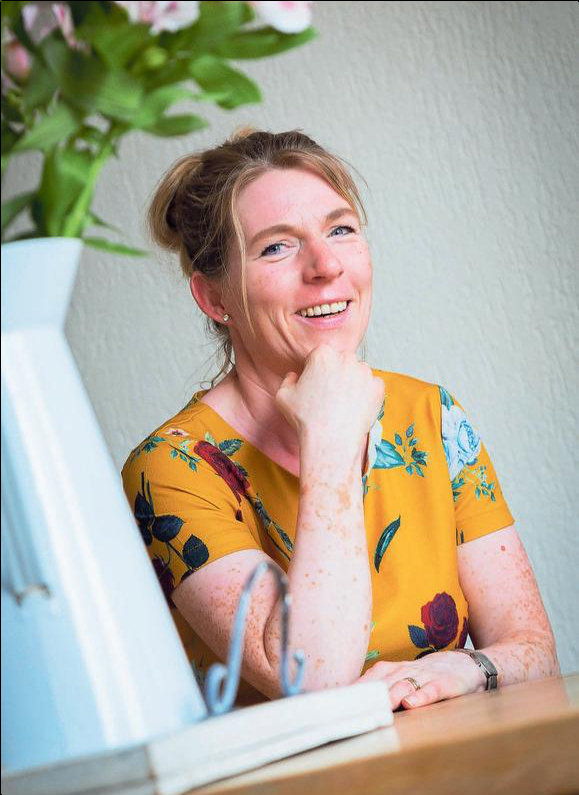
Every year on June 25, attention is drawn to vitiligo. Worldwide, people are thinking about the skin condition that occurs in 1 percent of people. The day before, the Hoogeveensche Courant puts Monique Pekel from Hoogeveen in the spotlight. She explains: 'Vitiligo is a disease in which the pigment cells disappear from your skin and hair. In places where pigment cells are no longer present, the skin remains white and you no longer tan. It is an autoimmune disease, which means that your own body breaks down good cells. There is actually no identifiable cause for vitiligo.
I think I was about 19 years old when the first vitiligo spot appeared. I then spent 4 weeks on Interrail, traveling all over Europe by train. Since I naturally tan quite a bit, the first white spots on my face were noticeable. Then over the years some spots kept appearing. Over the years I have learned to live with my vitiligo. I won't say that I have accepted it, but I don't want to let it affect my quality of life anymore.
So I just do everything I would do without stains. I think that your own attitude also determines how others view it. I also joke about it nowadays, a bit self-mockery. Then I buy a shirt with a leopard print and just say that it suits my mottled skin. Ultimately, you have the choice of how you deal with them... do you let your spots determine your life? In my case, not anymore, because it doesn't change anything, it is the way it is!
Adults say little about it. Of course they see it, but they never actually ask about it. People close to me say that they don't even see it anymore and don't pay attention to it, but I find that difficult to understand. Children are very honest and ask how the white and brown spots on my skin appear and carefully touch them.
I am a teacher in a preschool group and there are always children who ask what it is, how I got it and whether it hurts. I then explain it and then it is ready for them. That's the great thing about little children, they say and ask what they think, they are honest and pure. My daughters also both gave a talk about Vitiligo at primary school and I was allowed to attend, it is nice to bring it more to the attention of children in this way. Sometimes you meet fellow sufferers. Once when we were on holiday in Sweden, a man saw that I had vitiligo and so did he, so a spontaneous chat started with someone you didn't know. I always enjoy meeting people with vitiligo because then you realize that there are more people who have this condition.
I love nice, warm weather, but for years I had to cross a threshold every time to show my bare arms and legs, let alone wear a bikini. In addition, the skin that no longer contains pigment burns very quickly. I always apply factor 50 and my skin can still sometimes burn if I don't keep applying it. Sometimes the blisters appear.
Years ago I bought summer clothes that could just about cover my white spots, but at a certain point that was no longer possible. Mentally this has an impact, I was constantly working on it; how can I hide it in a tactical way. I also preferred not to go swimming, partly because I was afraid that my camouflage would fall off my face again. I certainly didn't go underwater with my head. That was always the case, especially during the summer holidays
a dilemma, because I also wanted to have fun in the pool with my children. At some point I got over that. At the moment the vitiligo is all over my body and I think much less about the spots being visible, I just want to be able to wear a nice summer dress, with or without spots.
There are actually no treatments that work for everyone. Many treatments are also experimental. Since I have a progressive form, which doesn't stop, I don't start that. All I've done is camouflage therapy. This was when I had a lot of white spots on my face and wanted to camouflage them. Camouflaging that is quite a job to do every day, but without camouflage I wouldn't open the door for anyone. My face is now almost completely pigmentless and now I just use foundation to not look so white.'